Grimbeak, the Unyielding
A Plug-and-Play Encounter for Any Frontier Town

You notice the rustling first. It starts quietly, then swells until you can’t hear anything else. The sky darkens, and when you look up it seems to be alive.
It takes a moment for your eyes to adjust. The darkness is birds: sparrows, finches, hawks. Every type of bird you’ve ever seen and many you haven’t. They blot out the sun for what feels like an eternity.
Then they are gone, flying southward.
My kids are about to face something big in our next Nimble session, and I want it to feel big.
This will be the first time they fight a Legendary Monster, and I want to build up to the encounter. Partly to make the moment more epic, and partly to give them time to prepare. This is only a level 3 encounter, but it can but wipe out all of their hit points with a single unlucky die roll if they aren’t careful.
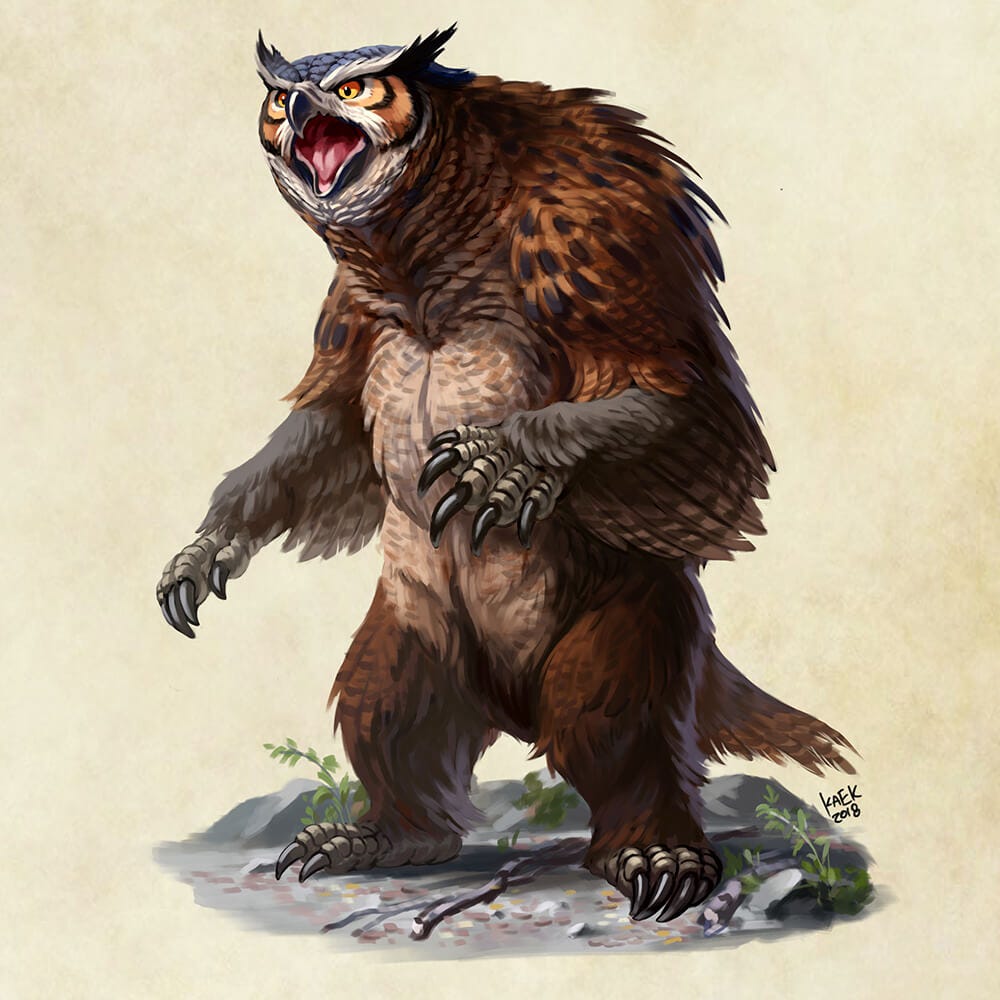
This is Grimbeak the Unyielding.
Building Up to Impending Doom
I’ve been thinking about Fronts in Dungeon World recently. If you’re unfamiliar, a Front is a way of organizing the threats in an adventure or campaign. Each Front includes an impending doom, the stakes involved, and a series of dangers and portents leading up to the doom.
The portents are especially useful. They’re the warning signs that appear while the danger goes unchecked. Strange events start happening. People start noticing something is wrong. They give the doom more narrative weight, and if they are ignored, the doom arrives.
In this case, the impending doom is Grimbeak, a massive and vicious owlbear.
During their last adventure, the characters killed several goblins in the nearby forest. That bloodshed put Grimbeak on their trail. The beast is slowly tracking them south, and will reach town in three days.
The portents begin with animals and monsters fleeing out of the path of disaster. Some of them won’t bother going around the town but will rush straight through it, becoming dangers to townsfolk and livestock.
An Encounter, not an Adventure
I designed Grimbeak as an encounter, not a full adventure.
My players already have several things keeping their characters busy in town, so the session won’t revolve around the owlbear. Instead, Grimbeak advances in the background while the characters deal with other issues. As the portents grow more severe, the situation in town becomes harder to ignore.
The players may decide at any point to investigate what’s happening. If they head north early, they will see some of the portents sooner and might even spot Grimbeak before she reaches town. That would give them some time to prepare.
If not… Grimbeak is still coming. And since she’s tracking them specifically, there isn’t a way to avoid this fight.
Using Grimbeak in Your Game
You can drop Grimbeak into any fantasy campaign with a nearby forest and a frontier town. Here is the outline I’m using:
Why Is Grimbeak Coming?
Grimbeak isn’t just a monster, she’s a response. In my game, she’s following the trail of blood the characters left behind after fighting goblins in the Emberwild. In your game, the reason could be something completely different.
The Oracle
Someone in town should have a least a little knowledge of Grimbeak. They won’t know everything, but they’ll recognize some signs and may guess why she’s coming. They will be a source of cryptic warnings and help build the tension, as well as give the characters a chance to prepare.
In my game, the oracle is the fairy Moonblossom, whom the characters recently saved from goblin kidnappers. In your game, the oracle could be almost anyone.
The Omens
Each day brings three developments:
a visible sign
a social ripple as townsfolk react
a nighttime escalation
These signs build tension as Grimbeak slowly approaches.
Day 1: The Sky Turns
Visible sign: A massive flock of birds floods overhead at midday. Some collapse from exhaustion. A DC 10 Naturecraft check reveals that some species normally live only in the nearby forest.
Social ripple: Dogs howl and bark. Livestock strain against their fences. Hunters return with unusually large hauls, saying the animals weren’t even trying to hide. The oracle should make a cryptic statement.
Nighttime escalation: Just before dawn, a horrible shriek echoes in the distance. For a moment, every animal in the area goes silent. The characters feel the sound in their chests.
Day 2: The Land Holds Its Breath
Visible sign: Birdsong disappears. Insects vanish. In the afternoon, rats, wolves and other animals rush through town heading south.
Social ripple: Hunters spot goblins and other forest creatures moving toward town, only to skirt around it. Livestock panic and some break loose from their pens. The oracle prepares for what’s coming.
Nighttime escalation: A hunter staggers into town in a panic. He claims he saw enormous glowing eyes watching him from a ridge. The shriek is heard again that night, much closer this time.
Day 3: Grimbeak Arrives
Visible sign: Huge clawed tracks circle the town. Fences are smashed. Several cattle lie dead. Feathers the size of shields litter the ground.
Social Ripple: Animals hide or refuse to move. Children are kept indoors. Several families pack their belongings and prepare to leave.
Nighttime escalation: A final shriek tears through the night, rattling windows and terrifying the remaining townsfolk.
Grimbeak attacks just before dawn.
Grimbeak, the Unyielding
Grimbeak appears in the Nimble Game Master’s Guide as the first Legendary Monsters in the book. I haven’t changed her stats at all.
If you want to use this encounter in another system, start with the normal stats for an owlbear and add the following extra traits:
Legendary: Acts after each character’s turn.
Brutal: Attacks with advantage. On a critical hit, the target is knocked prone.
Savage Shriek: At the start of combat and again when reduced to half HP, Grimbeak shrieks. Creatures within Near (30 feet) take beak damage that ignores armor.
Frightening: Targets hit by Savage Shriek must pass a DC 11 Will save or suffer disadvantage on ability checks and attack rolls and cannot move closer to Grimbeak. Effects last for one round.
Death Throes: When reduced to 0 HP, Grimbeak becomes even more dangerous. Her attacks deal double damage until she takes another third of her original HP in damage.
Closing Thoughts
I’ve been excited to run one of Nimble’s Legendary Monsters ever since I first heard about them. They’re designed to feel bigger than regular encounters, automatically scaling with the size of the party and having distinct stages that make them more boss-like.
At the same time, my kids’ characters have had a run of fairly easy victories lately. While that’s fun for a while, I want them to experience a real challenge. Legendary Monsters like Grimbeak aren’t the sort of enemies you can just charge in and smash through.
That said, the shift means I need to clearly signal the danger before it starts. That’s where the idea of Fronts has been really helpful. The concept of escalating portents gives me a simple way to warn the players while building tension in the story.
We’ll see how they respond when these warnings start appearing.
Other Thoughts
Shawn Merwin discusses what makes a good encounter on D&D Beyond: Let’s Design an Adventure: Encounter Basics
Dadi at Mystic Arts gives his methods for building up Boss fights: